



How to Source Waterproof Heat Shrink Connectors & Cable Lugs from a China Manufacturer: A B2B Buyer’s Compliance & QC Checklist
Why buy Waterproof connectors directly from a manufacturer instead of a trader?
A factory like Yueqing Gaopeng Electric designs and produces its own molds in-house, which means you get traceable material specifications, repeatable tolerances, and the flexibility to run OEM/ODM orders. Traders rarely control the production line, so batch consistency and certification paperwork can vary. Buying direct also shortens your communication loop when you need technical data sheets, salt-spray test reports, or a custom packaging layout for your brand.
What certifications should a compliant connector supplier hold?
Compliance is the single biggest risk in cross-border electrical sourcing, because a non-conforming connector can fail in the field and damage your reputation. Before you shortlist any supplier, confirm these four baseline credentials:
- ISO 9001: a quality management system that proves the factory has documented, repeatable processes — not just good intentions.
- CE marking: confirms the products meet applicable EU safety and EMC directives, essential if you sell into European markets.
- RoHS: restricts hazardous substances such as lead and cadmium, which is mandatory for most electronics distribution channels.
- SGS test reports: independent third-party verification of conductivity, crimp pull-out force, and corrosion resistance.
Gaopeng products carry ISO 9001, CE, RoHS and SGS coverage, so you can request the original certificates and match the certificate numbers to the exact product series you intend to buy.
How do I judge the real quality of heat shrink and Solder seal connectors?
Search results are full of look-alike connectors, so focus on measurable performance rather than marketing words. For waterproof solder seal connectors, ask for the ingress protection rating (a genuine IP67 seal should survive temporary immersion), the operating temperature range (Gaopeng solder seal connectors are rated from -55°C to 125°C), the salt-spray endurance (look for 1000-hour resistance), and the contact resistance value. For SC copper Cable lugs, the key indicators are copper purity, tin-plating thickness, and pull-out strength under load. Always request a physical sample and crimp it with your own tooling before committing to a bulk order.
What about MOQ, samples, and lead time?
Most reputable factories offer a sample stage before mass production. Clarify three numbers early: the minimum order quantity (MOQ) per SKU, the sample cost and whether it is refundable against a future order, and the production lead time after artwork or specification sign-off. For private-label buyers, also confirm the customization scope — box-packed retail kits, custom color coding, printed wire-gauge labels, or your own logo on the packaging are all standard OEM requests that a flexible manufacturer can accommodate.
Which connector type and size should I order for my application?
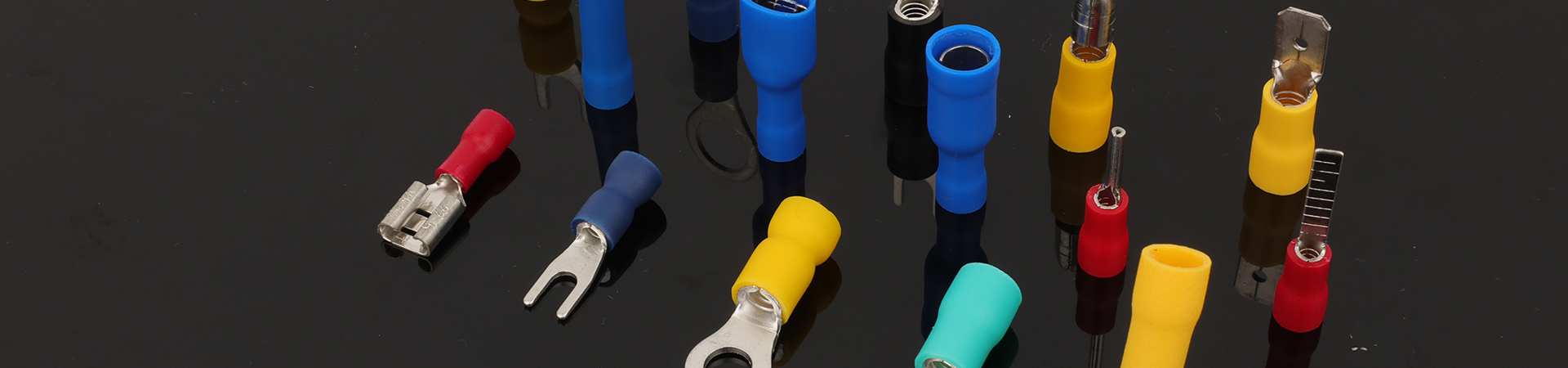
Choosing the right part prevents costly returns. Waterproof solder seal connectors are ideal for outdoor, automotive, marine, and solar installations where moisture ingress is the main threat, because the internal solder ring and adhesive-lined heat shrink form a sealed, gas-tight joint in one step. Heat shrink butt and ring terminals suit harness repair and vibration-prone equipment. PVC and nylon insulated crimp terminals are the workhorse choice for control panels and indoor wiring, while SC copper cable lugs handle high-current power transmission from 0.5 mm² up to large 630 mm² cables. Match the connector to your wire gauge (AWG or mm²), the stud or hole size, and the continuous current rating, and ask the manufacturer’s engineers to confirm the selection — a supplier that offers technical support rather than just a price list is a stronger long-term partner.
How should I run quality control before shipment?
Do not wait until goods arrive to inspect them. A simple, repeatable QC routine protects every order:
- Pre-production: approve a golden sample and lock the specification sheet in writing.
- During production: request in-line photos and dimensional checks for the first batch.
- Pre-shipment: run an AQL sampling inspection covering crimp integrity, seal continuity, plating coverage, and labeling accuracy.
- Documentation: collect the packing list, test reports, and certificate copies that match the shipped lot.
What payment terms and trade conditions are normal?
For a first order, a 30% deposit with the balance paid before shipment is a common and fair arrangement, and most established factories accept bank transfer (T/T) and trade-assurance channels. Confirm the Incoterms upfront — FOB and CIF are typical for sea freight — so you know exactly where responsibility for cost and risk transfers. Asking these questions early signals that you are a professional buyer and usually leads to faster, clearer quotations.
Final takeaway for B2B buyers
Sourcing waterproof heat shrink connectors and copper cable lugs from China is low-risk when you treat compliance and QC as part of the buying process, not an afterthought. Verify ISO 9001, CE, RoHS and SGS coverage, validate IP67 sealing and crimp performance on real samples, agree on MOQ and lead time in writing, and inspect before shipment. A manufacturer with in-house molds, full certification, and OEM/ODM capability — such as Yueqing Gaopeng Electric — gives distributors, panel builders, and brand owners a connector supply chain they can scale with confidence.